
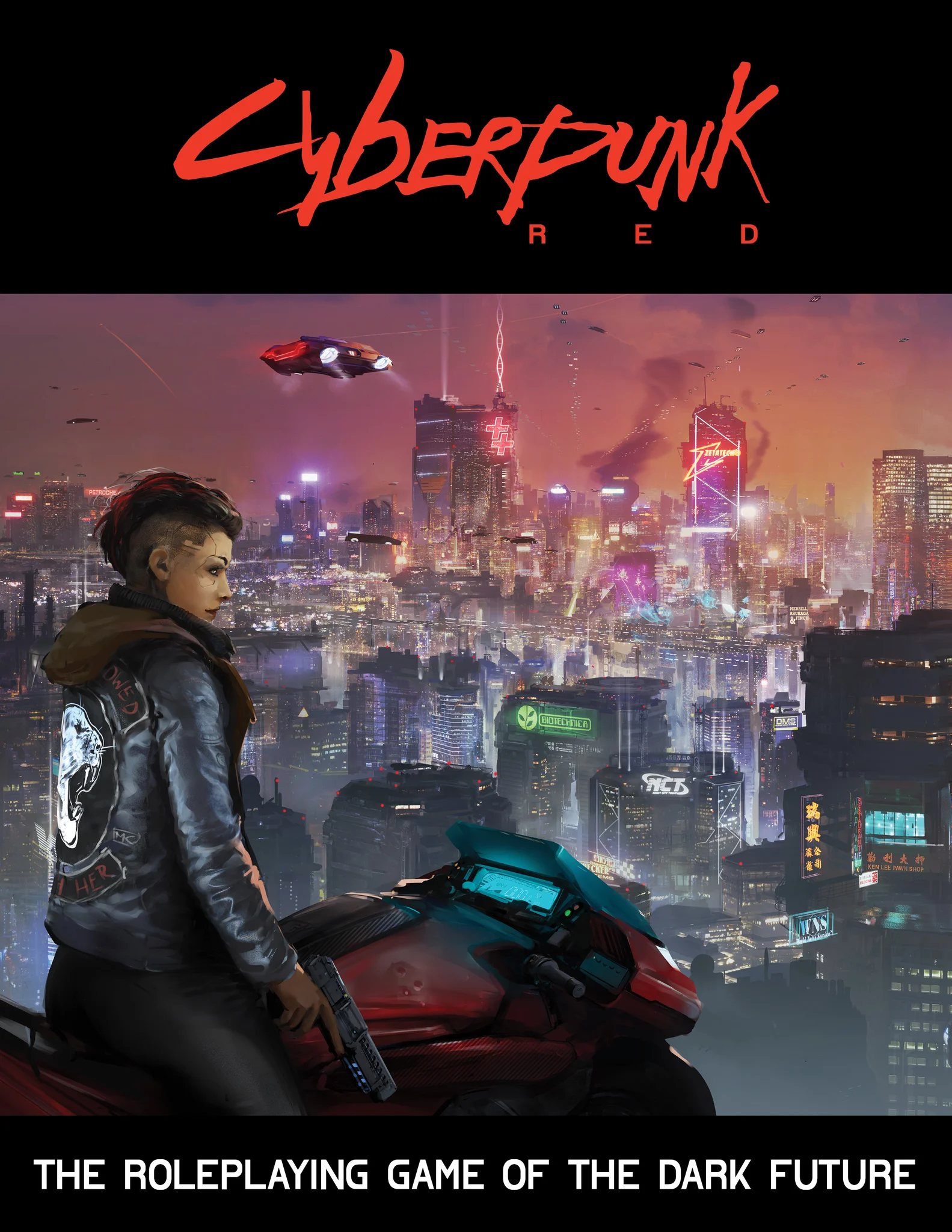
I fucking love cyberpunk, I love TTRPGs, it makes sense to review Cyberpunk RED when you put those together. Here we go, strap in. Cyberpunk RED is the successor to Cyberpunk 2020 by R. Talsorian, the IP behind the Cyberpunk 2077 video game. RED was developed alongside the Cyberpunk 2077 video game and has close ties to CD Projekt RED. I’ve run about 50 to 60 sessions of this game so far across three different campaigns and one-shots at my tables.
Name: Cyberpunk RED
System Type / Culture: OC, Neo-trad
See: The Retired Adventurer: Six Cultures of Play
Genre: Cyberpunk
No. of Players: 1–6 (with Solo Mode)
Release Date: 2020
Publisher and Author(s): R. Talsorian Games. Authors and designers include Mike Pondsmith, Cody Pondsmith, James Hutt, Jay Parker, J Gray, David Ackerman, and Jaye Kovach.
Link: https://rtalsoriangames.com/cyberpunk/
Introduction:
Cyberpunk RED is a robust d10-based system; in fact, the system only uses d10 and d6 dice. Its full-page (8.5” x 11”) layout spans 456 pages, making it a lengthy read. The game is set in the metropolis of Night City in 2045, during an alternate timeline where the world has fallen into a dystopian state. Big corporations, corrupt governments, violence, and the push for humans to augment their bodies with cybernetics are all chief themes here. The atmosphere of the rulebook is clear: push the pace, live on the edge, survive, and look good doing it.
Review:
How accessible is the system?
The accessibility of Cyberpunk RED is middling. A player needs to read about 100 pages of the rulebook to get familiar with the system. Its character creation process is straightforward, with a flow-chart approach that walks players through making their own Edgerunner (player character). The “Life Path” system, which allows players to essentially roll out their backstories, is particularly well done. Players at my table have greatly enjoyed this facet of character creation.
However, the layout of Cyberpunk RED’s rulebook leaves something to be desired. The use of repeated tables, the scattered presentation of a few key mechanics, and lore placement that breaks the book’s momentum all hamper clarity and structure, making the rules difficult to read at times. Not the worst layout I’ve come across (looking at you, DCC), but there’s room for improvement.
What is the system strong at?
Combat is a core strength of Cyberpunk RED. Its lethality sits in the Goldilocks zone for neo-trad games: just deadly enough. The way armour works (an ablation system), critical injuries, and itemization all contribute to a satisfying, fast-paced combat loop that just feels cyberpunk. The recommended balancing in the rulebook is too easy, though, and I would recommend the “hardened” variety of enemies at a bare minimum. These are available as free DLC PDFs from R. Talsorian’s website.
Atmosphere is also strong for RED. The rulebook has an edgy, unapologetic tone that’s refreshing. Many of the game’s mechanics reinforce the gritty cyberpunk atmosphere. For instance, installing cybernetic augments (cyberware) causes Humanity Loss, which can eventually cost your character their sanity. That’s just one example of various systems and items that double down on the cyberpunk aesthetic and the overall setting of the book.
Lastly, R. Talsorian’s approach to monetization is a breath of fresh air. Nearly every month, R. Talsorian releases free DLC with additional content for the game. And as the game has been out for six years at the time of writing, there’s a trove of free content to take advantage of. While this has lead to some game bloat (see below), the commitment to delivering regular, free, content to a player base should be held in high regard.
What is the system weak at?
Bloat is a concern at this point in the game’s development. There is a lot of content available between free DLC and paid supplements, with varying quality. In particular, I feel that some of the post-release content has taken away from the dark grittiness of the cyberpunk aesthetic; it feels campy. If you’re considering running RED, my recommendation is to start with the core rulebook and Black Chrome for your first venture into the system. The Fists of Fury supplement found inside Interface RED Vol. 4 adds some needed options to Martial Arts within the game, but it does so at the cost of game balance in many cases. It is best added after you have a good handle on combat, and even then, you may want to consider allowing only some of the new martial art forms into your games.
Another weak point is the “hardening” required by a game master to run RED in a way that feels true to the genre and atmosphere. Systems that encourage or even require you, as GM, to take adversarial stances against your players are what I’d coin as hardening. There are times in the rules where GMs are encouraged to take adversarial action against players to help maintain that cyberpunk feel. Players are too powerful? Just waste them. Players leave their van parked in a sketchy neighbourhood? Rob it. Players want access to a particular weapon? Sorry, that’s only available at a special “Night Market.” The more a GM takes action in opposition to their players without the support or requirement of explicit game mechanics, the more adversarial tension can arise at the table. I’d like to see more mechanical support for these types of actions to help ease the combative feel of implementing the harsh realities of a cyberpunk world for players at the table.
How much preparation is required to run a session?
I normally have a 1:1 ratio of preparation to session time, but Cyberpunk RED required more on average. 1.5:1 or even 2:1 was more common. Why is that, you ask? Creating meaningful, varied stat blocks for enemies (mooks), crafting Night Markets, and preparing Net architectures for your Netrunners (essentially the hacker class for RED) were the chief culprits here. In RED, the GM is firmly in control of gating access to items and equipment. And since character progression is heavily tied to equipment (unlike, say, D&D 5e), you really need to carefully consider how and when you introduce it into the game world so that players feel good about progression without making them overpowered. The bottom line? It was a very prep-heavy system for me.
Is the system worth owning, even if you never get to play or run it?
I would say no. There isn’t anything about Cyberpunk RED that I find particularly useful universally to the TTRPG space. Everything is tightly bound to this specific setting and system.
Rating: 7/10
There’s a lot to like about Cyberpunk RED as a whole. It can deliver an immersive, dangerous cyberpunk experience at your table in the hands of the right GM. But that’s really what holds Cyberpunk RED back as well: the emphasis on the curation required to run the game. Lots of content to review, lots of extras to prepare, planning to aid character progression, and fostering a dystopian and dangerous atmosphere without feeling adversarial all require nuance and experience. My final word on Cyberpunk RED is that it can be fucking fantastic, but you’ve got to invest the time and be intentional to make that happen.

As someone who has invested time in preparing and running TTRPGs, I commend your team for creating an engaging experience. It is not easy to achieve and sustain.
Thanks Bret, appreciate you taking the time to comment.